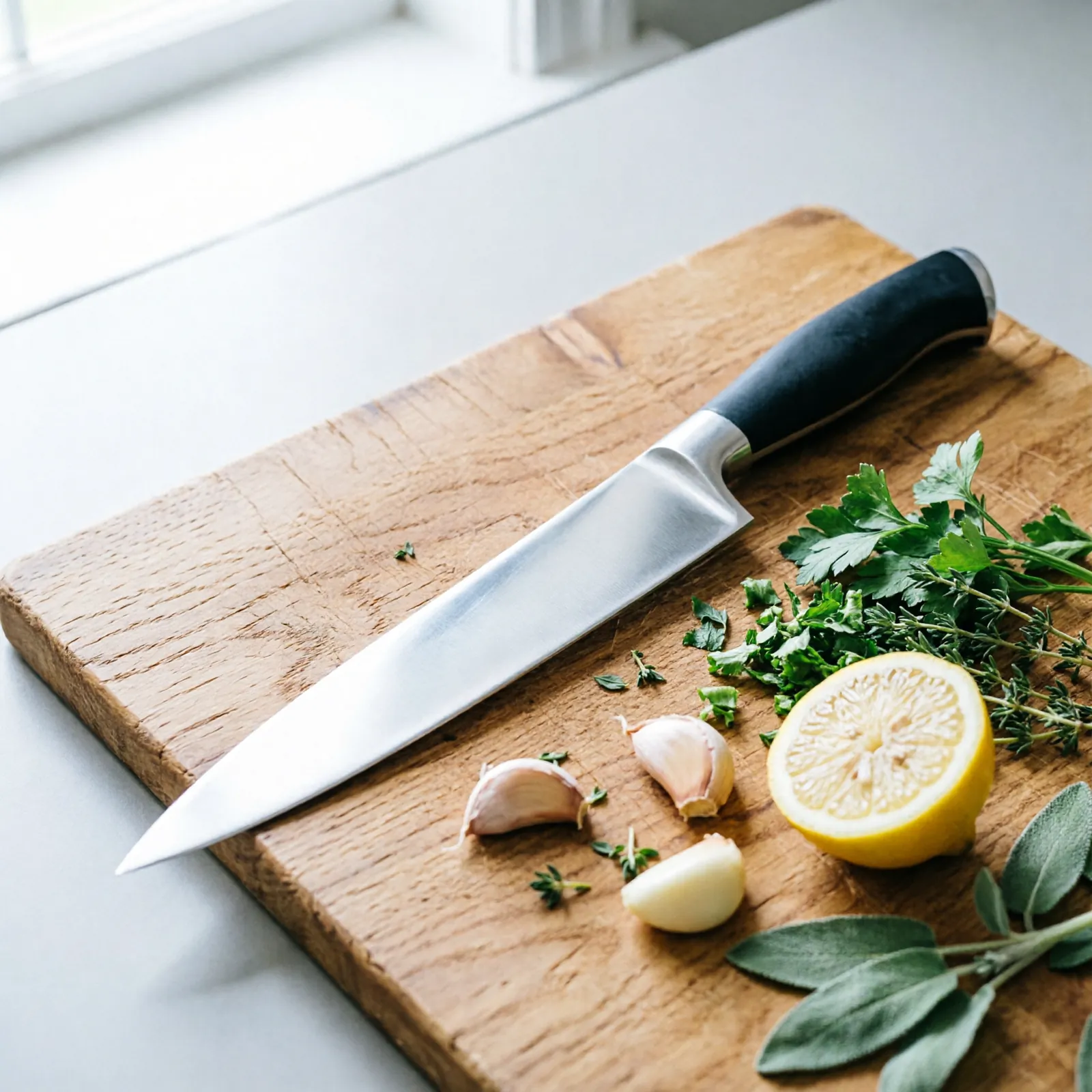
Overview
The knife we recommend to almost everyone — and a long-time favourite in professional kitchens, where it competes with blades costing many times as much.
We researched the Fibrox Pro 8-Inch Chef’s Knife from Victorinox against the criteria we use for this category: manufacturer specifications, patterns in verified owner reviews, independent testing published by others, and warranty and parts support. We do not test products in-house; what follows is our analysis, including the trade-offs that tend to show up only after the first few weeks of ownership.
Key features
A thin, light stamped blade
Stamped from relatively thin stock, the blade is lighter and slimmer behind the edge than most knives at this price, so it passes through vegetables with less wedging. That geometry matters more to everyday cutting than steel grade.
A handle that stays put
The textured Fibrox handle is designed to stay secure with wet or greasy hands — the reason it is common in commercial kitchens. It is unglamorous and it works.
Easy to maintain
Softer European stainless steel responds well to a honing rod and is forgiving on a whetstone. You do not need advanced skill or special equipment to keep it sharp.
Certified for professional use
NSF listed and approved for commercial kitchens — the same knife sold to restaurants, not a domestic variant with a different specification.
Pros & cons
What we like
- Exceptional value — very few knives at this price are as widely recommended
- Light and agile, which suits long prep sessions
- Grip designed to stay secure with wet hands
- Forgiving to sharpen and quick to hone back
- Cheap enough that you can own a second knife without guilt
What could be better
- The plastic handle looks utilitarian rather than beautiful
- Softer steel needs honing every week or two with regular use
- A stamped blade, not forged — no satisfying heft at the heel
- Not suitable for bones, frozen food or hard squash
Who it’s for
Anyone buying their first proper knife
If you are starting from a block of dull knives, one good chef’s knife changes cooking more than any appliance. Start here.
Home cooks who want less fuss
It needs honing, not a ritual. If you want sharp without learning advanced sharpening technique, this is the low-maintenance answer.
Students and shared kitchens
Affordable enough to replace without heartbreak, good enough that you will not want to.
Not for people who want an heirloom
It is a tool, not a showpiece. If the aesthetics matter as much as the cutting, look at forged Japanese or German knives instead.
Performance & notes
Sharpness out of the box
Owner reviews overwhelmingly describe the factory edge as sharp enough to slice tomatoes cleanly without pressure, and independent testing published over many years has repeatedly ranked it alongside knives several times its price. The 15° per side edge Victorinox lists is relatively acute for a Western knife, which is consistent with that reputation.
Handling and balance
At a listed 6.8 ounces it is light, with a blade-forward balance typical of stamped knives. On paper that makes it quick and easy to control for fine work like dicing onions, and less tiring over a long prep session than heavier forged knives — a point owners frequently raise. Cooks who prefer a heavy knife that falls through food under its own weight may find it too light.
Edge retention
The X50CrMoV15 steel, at around 56 HRC, is chosen for toughness and ease of sharpening rather than maximum edge retention. That is the right trade-off for most people. Expect to hone frequently and sharpen a couple of times a year — not the delicate handling that harder, more brittle Japanese steels demand. The most common owner complaint is simply that it dulls faster than premium knives, which the steel choice predicts.
Care and maintenance
Hand wash and dry it, as Victorinox recommends. A 1,000/3,000 grit combination stone is more than enough to keep it in excellent condition, and the softer steel is forgiving of imperfect technique. That makes it one of the best knives on which to learn to sharpen.
Specifications
Blade
- Length
- 8 inches (20 cm)
- Steel
- X50CrMoV15 stainless
- Hardness
- Around 56 HRC
- Edge
- 15° per side (listed)
Handle & care
- Handle
- TPE Fibrox, textured grip
- Weight
- 6.8 oz (193 g, listed)
- Dishwasher
- Hand wash recommended
- Certification
- NSF listed
The verdict
Our verdict
The best value in the entire kitchen category
Knives costing ten times as much have not dislodged the Fibrox Pro from the top of countless recommendation lists, and the reasons are clear from its design and from owner feedback. It cuts very well, its light weight suits long sessions, and the steel is forgiving enough that you can maintain it yourself without practice. Buy this knife, a honing rod and a wooden board, and you have upgraded your cooking more than any gadget would.
Overall rating
4.8/5
Opens Amazon in a new tab. We may earn a commission — it never affects our recommendations.
SnagaReview is reader-supported. When you buy through links on our site we may earn an affiliate commission at no extra cost to you. Read our full affiliate disclosure.
Frequently asked questions
Should I choose an 8-inch or 10-inch chef’s knife?
Eight inches suits most home cooks and smaller cutting boards. Ten inches gives more blade for large vegetables and long slicing strokes, but it takes more control. When unsure, choose eight.
Does it need sharpening straight away?
No — owners consistently report it arrives sharp. A honing rod every week or two should keep it that way for months before you need a stone.
Is a stamped blade worse than a forged one?
Not in any way that meaningfully affects cutting. Stamping is cheaper to produce and lighter in the hand. Forging adds weight and cost, and a bolster, without changing how well the edge performs.
What should I not cut with it?
Bones, frozen food, hard winter squash and anything you would need to lever or twist. Those tasks damage thin blades and are what a cleaver or heavy utility knife is for.